Introduction: What If We Have Been Looking at Time the Wrong Way?
What if everything we understand about reality, time, and existence is only a small part of something infinitely greater? What if the universe we experience is not fundamental reality itself, but an expression of something deeper? And what if the most important event in human history was not simply something that happened approximately 2,000 years ago, but the central event upon which the meaning of all existence rests?
I have been contemplating these questions as I explore quantum information theory, consciousness, the nature of reality, and my growing relationship with Jesus Christ. There is a philosophical hypothesis that our universe could be a simulation, a reality generated through some deeper informational process. I am not suggesting that science has proven this. It has not. But the possibility raises an extraordinary question. If our physical reality is somehow generated from a deeper foundation, what is the origin of that foundation?
As a Christian, I find myself returning to the Cross. Not simply as a historical symbol of suffering or sacrifice, but as something much more profound. An intersection between eternity and time. Between the Creator and creation. Between the beginning and the end. Between everything that has ever existed and everything that will ever exist.
What if the Cross of Jesus Christ is the point upon which the past and future are eternally anchored? And what if the Resurrection reveals that the ultimate foundation of reality is not death, entropy, or destruction, but life itself?
This is not a scientific theory. It is a theological and philosophical exploration inspired by scientific questions. Yet the more I contemplate it, the more I recognize a possibility that deserves reflection. Perhaps we have been looking at the Cross as an event within time, when its deepest significance is that eternity entered time through Jesus Christ.
1. The Simulation Hypothesis: Is Physical Reality the Final Layer?
The simulation hypothesis suggests that what we experience as physical reality might be generated by an underlying computational or informational system. Philosopher Nick Bostrom famously explored the possibility that technologically advanced civilizations could create simulated worlds containing conscious beings. His argument does not prove that we live in a simulation. It examines the implications of several possible assumptions about technological development and simulated consciousness. Nevertheless, it challenges our intuitions about reality.
If a sufficiently sophisticated intelligence could generate an internally consistent world, would the beings inside that world necessarily recognize its underlying structure? Would they understand the true nature of their environment? Or would they experience their reality as completely natural, governed by the laws they observe?
These questions become particularly intriguing when considered alongside quantum information theory. Quantum mechanics demonstrates that physical systems possess informational properties that cannot be fully explained using classical physics. Entanglement, superposition, and quantum measurement reveal a universe far more complex than everyday experience suggests. Some physicists investigate whether spacetime itself could emerge from more fundamental quantum relationships.
But an important distinction must be made. A universe that can be described mathematically or informationally is not necessarily a computer simulation. Information theory does not prove the existence of a programmer, nor does quantum physics establish that reality is artificial.
Still, the simulation hypothesis provides an interesting philosophical framework. If reality has an underlying foundation, what might exist beyond the reality we observe? And could that question point us toward something that theology has contemplated for thousands of years?
2. Before the Beginning: The Eternal Logos
The Gospel of John begins with one of the most profound declarations in Scripture:
“In the beginning was the Word, and the Word was with God, and the Word was God.” — John 1:1, KJV
The Greek word translated as Word is Logos. In ancient Greek philosophy, Logos carried associations with reason, order, and intelligibility. Within John’s Gospel, however, the Logos is not merely an abstract principle. The Logos is divine and personal. John later declares:
“And the Word was made flesh, and dwelt among us.” — John 1:14, KJV
For Christianity, this is a foundational revelation. Jesus Christ is not simply a teacher who appeared within an already existing universe. He is the eternal Word through whom creation came into existence.
This introduces a distinction between the Christian understanding of creation and the simulation hypothesis. A simulated universe would ordinarily imply an external computational system operating according to some deeper physical reality. Christian theology instead describes God as the uncreated source of all existence, not merely a powerful intelligence operating a machine. God is not another object within the universe. Nor is God necessarily an engineer standing outside a digital environment. God is understood as the source upon which all created reality depends.
This is where my contemplation becomes particularly meaningful. If Jesus Christ is the eternal Logos, then His relationship with creation does not begin with His birth in Bethlehem. His existence precedes the physical universe. His incarnation is the entrance of the eternal Word into the creation He sustains. And His Crucifixion becomes an event whose significance cannot be confined to the moment in history when it occurred.
3. The Cross: Where Eternity Intersects Time
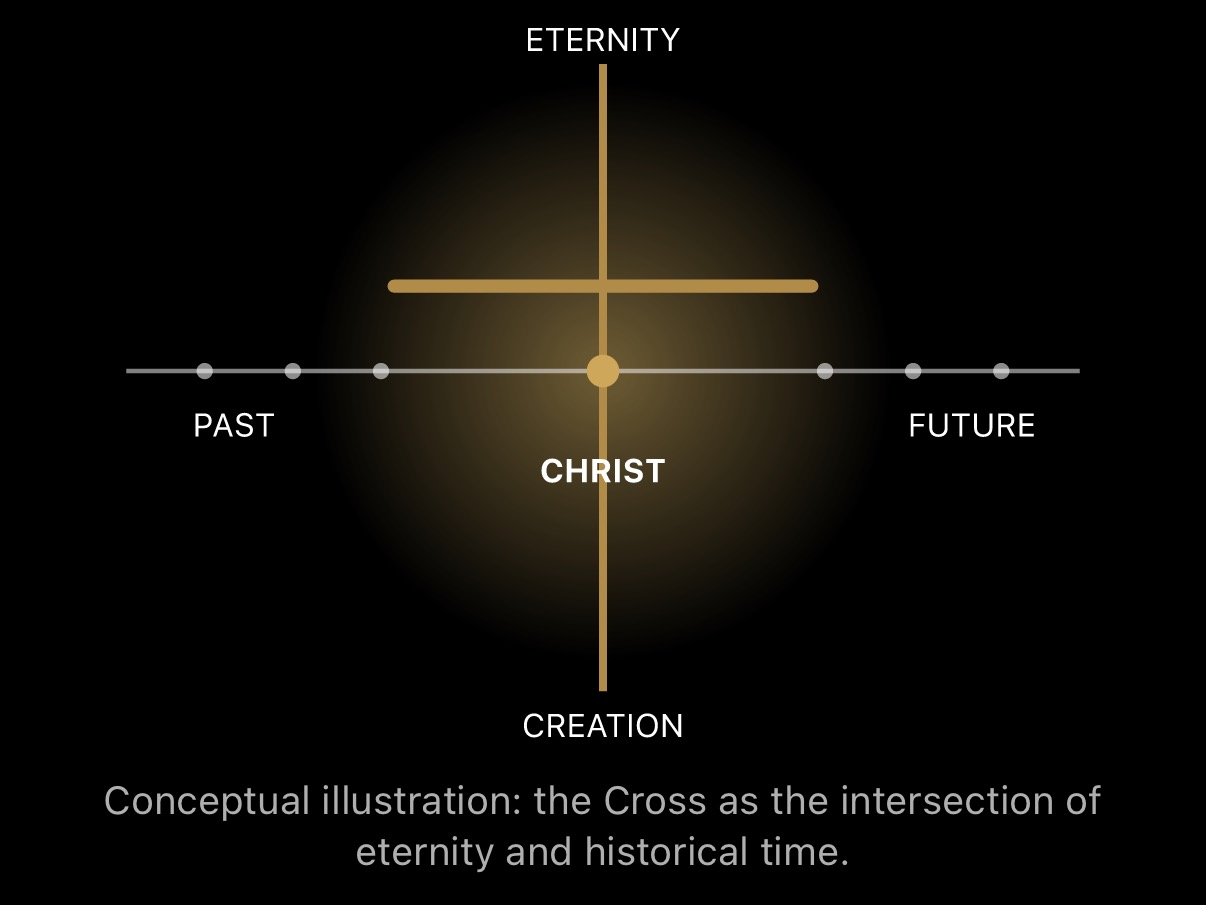
Consider the physical shape of the Cross. A vertical beam. A horizontal beam. And a single intersection.
The horizontal beam can symbolize time. To one side, the past. To the other, the future. Every civilization that has risen and fallen. Every human life that has begun and ended. Every moment that has ever existed and every moment yet to unfold.
The vertical beam can symbolize eternity. The divine dimension of existence, not confined by the chronological boundaries through which human beings experience life. At the intersection stands Jesus Christ. Fully human. Fully divine. The eternal Logos entering the physical world.
This symbolism does not establish a literal geometric structure of spacetime. It is a contemplative image. But it offers a powerful way to understand the Christian claim that the Cross possesses significance beyond one historical moment. The past stretches toward the Cross. The future unfolds from the Cross. And eternity meets history in Jesus Christ.
The Cross is therefore not simply a marker along a timeline. It becomes the theological center of the entire story of creation and redemption. Everything before it points toward the promise of reconciliation. Everything after it exists in the light of what Christ accomplished. And the Resurrection reveals that the story does not end in death.
4. What If the Beginning and End Are Held Together in Christ?
Human beings experience time sequentially. Yesterday becomes today. Today becomes tomorrow. We remember the past, experience the present, and anticipate the future. But does the fundamental nature of reality require time to exist exactly as we experience it?
Einstein’s theory of relativity transformed our understanding of time. Time is not a universal clock ticking identically for every observer. Its measurement depends on motion and gravity. Certain philosophical interpretations of relativity, including the block-universe view, treat past, present, and future as parts of a four-dimensional spacetime structure. This interpretation remains a subject of philosophical discussion, particularly regarding the nature of temporal passage. It does not establish divine eternity. But it demonstrates that our intuitive experience of time is not the only framework through which time can be understood.
Christian theology has long contemplated God’s relationship with time. In classical Christian thought, God is not limited by temporal succession in the way created beings are. God’s eternity is not merely an endless sequence of moments. It is a mode of existence beyond the limitations of created time.
Now consider the words of Jesus in Revelation:
“I am Alpha and Omega, the beginning and the end, the first and the last.” — Revelation 22:13, KJV
What if we contemplate the Cross through that declaration? Not as a mechanism controlling time. Not as evidence of a simulated universe. But as the historical revelation of the One through whom beginning and end find their ultimate meaning.
From this perspective, creation is not an accidental process that eventually produced Jesus Christ. Rather, within Christian theology, the eternal Son is central to God’s purpose for creation. The Cross becomes the meeting place of history and eternity. And Christ becomes the One in whom the meaning of the entire timeline is revealed.
5. Was the Cross Central Before Creation?
This leads to an even deeper theological question. Was the Cross part of God’s redemptive purpose before the physical universe existed?
The New Testament contains passages that Christians have long interpreted in relation to God’s eternal purposes. Ephesians 1:4 speaks of God’s choice in Christ before the foundation of the world. First Peter 1:19–20 describes Christ as the sacrificial Lamb foreknown before the foundation of the world. Revelation 13:8 also connects the Lamb, the book of life, and the foundation of the world, although translations and interpretations differ concerning the precise relationship between these phrases.
These passages invite a profound contemplation. The Crucifixion occurred at a particular moment in human history. Yet the Christian understanding of God’s redemptive purpose is not restricted to that moment. The Cross can therefore be understood as historically situated but eternally significant.
This does not require us to imagine that the physical universe literally began at Calvary. Nor does it mean that time moved backward or forward from the Crucifixion. Rather, it suggests that the meaning of the Cross reaches across the whole of salvation history. The event is historical. Its significance is eternal. The Cross happened within time, but its redemptive meaning is not imprisoned by time.
6. If Reality Is a Simulation, Who Is the Creator?
Suppose, purely as a thought experiment, that our physical universe is generated through an underlying informational structure. Would that change the question of God? Not necessarily. A simulated reality would still raise questions about the origin of the system generating it. Where did the underlying laws come from? Why does anything exist rather than nothing? What explains the existence of the intelligence or physical process responsible for the simulation? A simulation hypothesis could move the question of origins to another level without ultimately resolving it.
This is where Christian theology offers a different framework. God is not simply the first engineer in a chain of engineers. God is the uncreated source of being itself. And Christianity makes an even more extraordinary claim. The Creator entered His own creation.
Through the incarnation, Jesus Christ became genuinely human. He experienced hunger, suffering, relationships, love, betrayal, and death. He did not merely observe humanity from beyond the boundaries of creation. He entered the human condition.
If we use the simulation hypothesis as a metaphor, this would be something far more profound than a programmer entering a virtual environment. It would be the source of existence entering the world He sustains, not as an illusion, but as a real human being. And doing so not merely to reveal information, but to reconcile humanity with God.
This is where the metaphor must stop. Christianity does not teach that the physical world is unreal or that human suffering is merely programmed. The incarnation affirms the reality and value of embodied human existence. The Cross matters precisely because the suffering, sacrifice, and death of Jesus were real.
7. The Resurrection: The Transformation of Death
If the Cross is the center of redemption, the Resurrection is essential to understanding what that redemption means. Christianity does not end with the death of Jesus. It proclaims that He rose from the dead.
The Resurrection is not simply the survival of an idea, the continuation of information, or the persistence of a memory. It is the Christian claim that God raised Jesus bodily from death. That distinction is essential.
In physics, information conservation and the fate of quantum information are subjects of important research. But those concepts do not establish the Resurrection. The Christian belief in resurrection rests on theological and historical claims, not on an equation from quantum information theory.
Nevertheless, the contrast is philosophically compelling. Physical systems are subject to entropy, transformation, decay, and death. Christianity proclaims that death is not the ultimate destiny of creation. The Resurrection represents the promise of new life and the restoration of creation.
If the Cross is where the story of redemption reaches its decisive moment, the Resurrection reveals the direction toward which that story moves. Not toward eternal destruction. But toward renewed creation. Not toward the final victory of death. But toward life.
8. Quantum Information, Consciousness, and the Search for God
As I continue exploring quantum information theory, I am increasingly fascinated by the relationship between the physical universe and the experience of being conscious within it.
Human beings are extraordinary. We are made of matter. Our bodies exchange energy with the environment. Our brains process information through complex biological systems. Yet we experience love, sorrow, beauty, gratitude, and the awareness of our own existence. We can contemplate the universe. We can question our origins. We can seek meaning. And we can enter into prayer.
Science investigates the physical mechanisms associated with cognition and consciousness. But the philosophical question of why subjective experience exists remains unresolved. Quantum physics has not established that consciousness creates reality. Nor has it demonstrated that prayer manipulates quantum fields or that spiritual awareness operates through measurable quantum frequencies.
I believe it is important to acknowledge these boundaries. Faith does not need unsupported scientific claims to possess meaning. For me, the relationship between science and spirituality is not about forcing one to prove the other. It is about remaining open to the extraordinary depth of existence.
When I pray, I am not attempting to manipulate a hidden computational system. I am seeking communion with God. When I become still and present, I am not claiming to escape the laws of physics. I am learning to experience life with greater awareness, gratitude, and peace. And when I contemplate Jesus Christ, I am not searching for a secret mathematical code. I am seeking a deeper relationship with the One whom I believe to be the Son of God.
Perhaps the greatest transformation is not discovering that reality is a simulation. Perhaps it is awakening to the significance of being alive within God’s creation.
9. The Cross as the Anchor of Past, Present, and Future
I keep returning to the image of the Cross suspended at the center of time. The past extending in one direction. The future extending in the other. Eternity intersecting both. And Jesus Christ at the center.
Every generation before Christ lived within the unfolding story of creation. Every generation after Christ lives in the historical aftermath of His life, death, and Resurrection. Yet the significance of the Cross is not limited to chronology. It also speaks to the human experience of time.
We carry memories of the past. We anticipate uncertainties in the future. We often allow regret, resentment, fear, and expectation to dominate the present. But the teachings of Jesus repeatedly invite us into trust, love, forgiveness, and faithfulness.
Consider Matthew 6:34, where Jesus teaches us not to be consumed by anxiety about tomorrow. This is not a denial of responsibility or the need to plan. It is an invitation to stop allowing the future to control our inner lives. Likewise, the Cross speaks to the possibility of reconciliation with the past. Through repentance, grace, and forgiveness, we are invited into a new relationship with God and one another.
We cannot reverse history. But our relationship with what has happened can change. The future remains uncertain from our human perspective. Yet Christian hope teaches that our ultimate destiny need not be defined by fear.
In this sense, the Cross becomes a spiritual anchor. Not because it alters the equations of time. But because it changes how we understand our existence within time. The past can be met with forgiveness. The future can be met with hope. And the present can be lived in communion with Christ.
10. What If the Purpose of Creation Is Love?
This may be the most important question of all. Suppose we eventually discover that the universe possesses a deeper informational structure. Suppose quantum gravity reveals that spacetime emerges from relationships we cannot yet fully comprehend. Suppose artificial intelligence and quantum computing transform our understanding of information and physical reality. Would those discoveries tell us why existence matters? Would they explain why love is meaningful? Would they tell us how to treat one another?
Science can reveal the mechanisms through which physical systems operate. But scientific descriptions alone do not determine moral purpose. Christianity places love at the center of its understanding of God. John 3:16 declares:
“For God so loved the world, that he gave his only begotten Son…” — John 3:16, KJV
The Cross is not merely an intersection of symbolic dimensions. It is the revelation of sacrificial love. It speaks of a God who does not remain distant from human suffering. A God who enters the world. A God who gives Himself for humanity. And a God who calls us to love one another.
If we ask what gives meaning to the story of creation, the Christian answer is not ultimately a computer program, an algorithm, or a mathematical equation. It is the God revealed in Jesus Christ. And if the Cross stands at the center of that story, then love is inseparable from its meaning.
This changes the question. Instead of asking only whether we live in a simulation, perhaps we should also ask: How should we live if creation is sustained by a God whose nature is love?
11. Living at the Intersection of Eternity and Now
The more I contemplate these ideas, the more I find myself drawn toward simplicity. I do not need to understand every mystery of quantum mechanics. I do not need to prove that the universe is a simulation. I do not need to explain the complete nature of time or consciousness.
There is extraordinary value in scientific discovery, and I intend to continue exploring it. But I am also learning that peace does not require possessing every answer. My spiritual journey is becoming less about accumulating knowledge and more about allowing that knowledge to deepen my humility. To become more present. To listen more carefully. To forgive more readily. To recognize the dignity of others. To live with greater compassion. And to walk more faithfully in the footsteps of Jesus Christ.
The Cross reminds me that the center of Christian faith is not simply intellectual understanding. It is a relationship. A relationship with the living Christ. A relationship that invites transformation not only in what I believe, but in how I live. Perhaps that is where eternity and time meet in our own experience. Not because we have escaped physical reality. But because the eternal significance of Christ can transform the way we inhabit the present moment.
Conclusion: The Cross Is Not Merely Within the Story. It Gives the Story Its Meaning.
I began this contemplation with a question. What if reality is a simulation? What if the universe emerges from a deeper informational foundation? And what if the Cross of Jesus Christ is the point upon which past and future are anchored?
I cannot claim that quantum physics proves these ideas. It does not. Nor can I claim that simulation theory provides evidence for the Christian understanding of creation. It does not. But I can recognize that these questions invite us to reconsider our assumptions about existence. Quantum information theory reveals that physical reality is far more subtle than classical intuition suggests. Relativity challenges our everyday understanding of time. Cosmology continues to investigate the origins and structure of the universe. And Christian theology presents a vision in which the eternal Logos enters creation, experiences human life, dies upon a Cross, and rises again.
For me, these ideas converge upon something deeply personal. What if the Cross is not simply an event that occurred within time, but the eternal reference point through which the meaning of all time is revealed?
I envision the horizontal beam of the Cross extending through history, reaching backward toward the beginning of creation and forward toward the fulfillment of God’s promises. I envision the vertical beam representing eternity, connecting the world we experience with the divine reality that transcends our understanding. And at the intersection stands Jesus Christ. The Alpha and the Omega. The beginning and the end. The One through whom all things were created and in whom all things hold together.
In this understanding, the Cross is not merely a symbol of suffering. It is the center of redemption, where the eternal love of God enters the brokenness of human history. The past and future are not literally attached to two pieces of wood. They are held within the eternal purpose of the One who willingly gave His life upon them. And perhaps that is the deeper meaning of the image that continues to occupy my thoughts. The Cross does not need to exist outside time to transform the meaning of everything within it.
If our universe were someday shown to be a simulation, that discovery would not diminish my faith in Christ. It would simply raise another question about the nature of creation and the source of the reality beneath it. But I do not need the universe to be a simulation to believe that God is its Creator. I do not need quantum mechanics to prove that Jesus Christ is Lord. And I do not need to understand every mystery of time, consciousness, or existence to recognize the transformation taking place within my own life.
As I grow older, I find myself becoming less concerned with proving that I understand the universe and more concerned with understanding how I am meant to live within it. I have spent much of my life exploring energy, technology, innovation, and the possibilities of human achievement. I continue to believe that science and engineering can transform our world for the better. But I am also discovering that knowledge and wisdom are not the same thing. We can understand the movement of electrons without understanding the movement of the human heart. We can develop artificial intelligence capable of processing extraordinary amounts of information without fully understanding consciousness. We can explore the origins of the universe while still struggling to understand the purpose of our own existence. And we can spend an entire lifetime searching for answers outside ourselves while overlooking the importance of love, forgiveness, humility, and faith.
My relationship with Jesus Christ is teaching me to see these things differently. The Cross reminds me that my past does not have to define my future. It reminds me that forgiveness is possible, that suffering need not be meaningless, and that love is greater than the fear that so often governs our lives. The Resurrection reminds me that death does not have the final word. And the teachings of Jesus remind me that the most important transformation may not be the one taking place in technology or civilization, but the one taking place within our hearts.
I find increasing peace in that realization. Perhaps the greatest mystery is not whether the universe is a simulation. Perhaps the greater mystery is why a universe capable of producing galaxies, stars, planets, and conscious life also contains the possibility of love, sacrifice, forgiveness, and a personal relationship with God. And perhaps the most important question is not how reality was constructed, but what we are called to do with the life we have been given.
I cannot see the beginning of time. I cannot see the end. I cannot fully comprehend eternity. But I can stand in the present moment and choose how I live. I can choose compassion over judgment. Forgiveness over resentment. Humility over pride. Faith over fear. And love over the illusion that I am somehow separate from the people and world around me.
When I contemplate the Cross, I no longer see only an event from ancient history. I see the intersection of everything I have been, everything I am, and everything I may yet become through the grace of God. I see a reminder that my life is part of a story far greater than my individual existence. And I see Jesus Christ, not as a distant figure confined to the past, but as the living center of my faith today.
Maybe one day science will reveal a deeper informational foundation beneath the physical universe. Maybe our understanding of time will change in ways we cannot presently imagine. Maybe the next great discovery will challenge everything we believe about matter, energy, and consciousness. I welcome those discoveries. I believe truth is worth pursuing wherever it leads. But whatever science ultimately reveals about the structure of reality, I find my spiritual foundation in something that does not depend on a technological explanation. The life, teachings, Crucifixion, and Resurrection of Jesus Christ.
If time is the canvas upon which creation unfolds, then the Cross is where I see the eternal love of God revealed within that creation. The past reaches toward it through the story of redemption. The future carries forward its promise of hope. And the present is where each of us has the opportunity to respond.
Perhaps we will never fully understand the nature of reality while living within it. But we can seek to understand the purpose of our lives. We can become more conscious of our choices, more compassionate toward others, and more faithful in our relationship with God. And we can recognize that the greatest expression of divine power may not be found in the creation of galaxies or the mysteries of quantum physics, but in the willingness of Jesus Christ to give His life for humanity.
That is what the Cross means to me. Not simply the intersection of two wooden beams. Not merely a moment in history. And not a mathematical point in some hypothetical simulation. It is where eternity touched humanity, where love confronted death, and where the promise of redemption became the defining center of my faith.
The universe may contain mysteries beyond anything we can presently comprehend. But as I continue my journey through science, technology, consciousness, and faith, I find myself returning to one enduring truth. I do not need to know how the entire story of existence unfolds to know where I choose to place my trust. I place it in Jesus Christ. The Alpha and the Omega. The beginning and the end. The One who was, and is, and is to come. And in that faith, I find something I spent much of my life searching for. Peace.
Perhaps the Cross is not where time began, but where the eternal meaning of time was revealed. And perhaps the most important discovery we can ever make is not the true architecture of the universe, but the love of the One who created it.